Showing posts with label Kiyoshi Kurosawa. Show all posts

Thursday, January 16, 2014

First Impressions: Kiyoshi Kurosawa's Real (2013)


I liked Real a good bit, though it is a departure for Kurosawa in significant ways that have fought off a few qualities I value in his art - namely, it seems that working from source material has flattened him narratively and thematically (gone are those idiosyncratic airs of anomalous tone and plot construction; here the mysteries of thought and behavior are approached as mere puzzles to be unlocked instead of regarded as symptoms) and visually it is almost too good looking, with the rough-hewn edges that have defined so many of his previous visual conceptions almost entirely smoothed over, with sleek architecture and rich foliage sitting in for dilapidation (the one decaying location portrayed is explicitly lamented for and, thus, benign).

Still, Kurosawa, one of the great "protractor-and-metronome" directors (as Ray Durgnat once referred to Lang and Murnau) is able to flex his mastery of rhythm and the ability to conjure unease, and what is most interesting about Real is that this takes place within what is essentially the director's crack at the 'virtual sandbox' subgenre, here taking the idea of intrusion into another's mind and, through its depiction of space, agency and challenge, renders something analogous to the open-air video game experience. Kurosawa is of course no member of any video game generation, and so what we get is not, obviously, the kind of breakneck thing that, say, Neveldine/Taylor or the Harold and Kumar movies (the latter being more unconscious experiments in sandbox realization) offer up, but instead something more composed and curious/suspicious, an "old man's" video game movie, like Cronenberg's eXistenZ (eternally underrated). What these two movies have in common (and some of Phil Solomon's experimental work deals with this also) is an attention to and patience with the vacant details of their environments, a mise-en-scene that forges a dialectic between the attractive freedoms and the inherent artificiality and loneliness of these experiences. Real may lose its footing a bit in a last act that would maybe seem more at home in a Bong Joon-ho picture, but there is a strong feel of mournful investigation here that's hangs in my memory above most of the weaknesses.

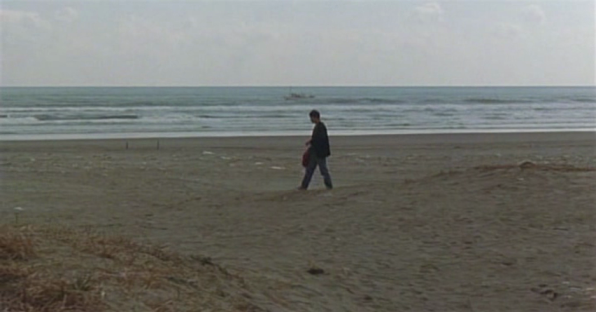
Real (Kiyoshi Kurosawa, 2013)

eXistenZ (David Cronenberg, 1999)

Real (Kiyoshi Kurosawa, 2013)

eXistenZ (David Cronenberg, 1999)


Sunday, November 4, 2012

Strangers / K.K.


Even with an opening act that Rivette would remake many times over in spirit (the gamey hunt for an elusive figure whose actions have layed down trajectories for the others / but does he even exist?) and a middle sequence involving a dark hotel room and a note slid under a door that matches the quiet menace of anything Lewton or Lang would do in the decade, still the most striking thing about When Strangers Marry is it's insistence that the outlandish happenings of it's insular melodrama occur within a vital, bustling, breathing world. Tracking shots that fluidly incorporate peripheral working stiffs, and extended asides into lively public spaces that make no pretense of narrative import; again and again moments are sprinkled in that lie entirely outside of the story being told, at once lending a potent quotidian contrast to the central cloud of violence and uncertainty, while also providing a larger context into which the blood that's spilt must inevitably flow.

Castle's visual style here is never less than entirely arresting, yet the most effective shot in the entire movie may be one of the simplest: a malevolent, downward gaze directly into the camera from Mitchum. Not only because of what it conveys about the character with such chilling simplicity, but also because it feels like nothing short of the birth of Harry Powell right before your eyes.

_____________________________________________________


"Both formally and thematically, Kurosawa Kiyoshi's films are a series of fluctuations between rigid and chaotic elements, grids in which emphasis is placed variously on the lines and the spaces. The lines: the hard angles of his long-take shots, sectioning the screen in balanced but asymmetric compositions; the confines of genre; the habitual codes of consensual reality. The spaces: unexpected activations of seemingly static planes or elements within those strict compositions; pushing generic considerations to a larger, allegoric frame of reference, then beyond to ambiguous apocalypse in which an old order/means of perception is abolished in an act of either nihilism triumphant or possibility affirmed - or maybe both, an affirmative nihilism."

- B. Kite, "A Kurosawa Kiyoshi Kit"


"It is nonsense to argue over whether giant monsters or dead people are scarier. How good or bad a film is isn't dependent simply on how scary it is. I just want to give the generic name "horror films" to that family of films that take as their subject matter the fear that follows one throughout one's life.....Now that I think about it, since there are no works that have failed to change my life even a little bit, all films are horror films."

- Kiyoshi Kurosawa, "What is Horror Cinema?"