Showing posts with label David Lynch. Show all posts

Tuesday, January 21, 2014

End of the Road

La marge (Walerian Borowczyk, 1976)

Lost Highway (David Lynch, 1997)

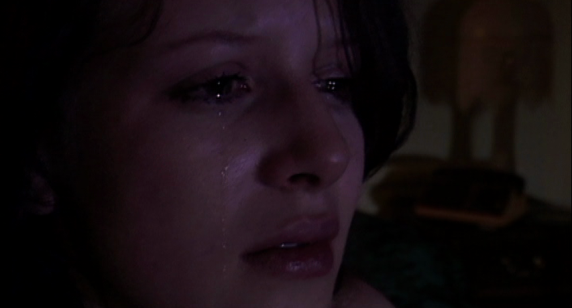
The similarities in this instance not being solely limited to the image, but extending to facial ticks, presumed state of mind, presumed fate, and placement within the duration of the film. Because La marge could not innacurately be described as a somnambulistic Joe Dallesandro leaving his family to wander around nighttime Paris and have strange sex, it's drawn comparison in some quarters to Eyes Wide Shut, which I think holds a little more water on paper than it does during the actual act of watching. What was evoked for me was Lynch at times (though it often feels like he's destined to live in the back of my eyes forever) as well as, in its occasional status as a piece of erotica that seemingly can't wait to shake off its flesh, Jean Rollin. And the non-condescending, detailed interludes of brothel lifestyle, with their casual immediacy and ellipses, gives a hint of what Pialat's L'Apollonide might have looked like. (If La marge is great, and it might be, it is so because of these sequences.) But none of that quite gets at the movie's own peculiarities of style and attention, the odd appropriateness of its disarming musical choices, the manner in which its play of ideals and their oblivion accumulates a gravity that should be next to impossible to wring from its initial eye-rolling portrayals of the former.

As my first dip into the work of Borowczyk I am without auteurist context here, but I did watch Touch of Evil again last night, so maybe the best way to leave it is to say that La marge is some kind of a movie.

Tuesday, October 2, 2012

Blue Tomorrows


Nearly a decade before INLAND EMPIRE, Satoshi Kon gives us in Perfect Blue images of a woman in trouble, a bloody screwdriver, personal surveillance, the complete collapse of reality and fiction, of performer and performance, and reunion and blinding light as a way out.

Wednesday, August 29, 2012

Points of Contact: The Big Mouth

The Big Mouth (Jerry Lewis, 1967)

Zorns Lemma (Hollis Frampton, 1970)

________________________________________________

The Big Mouth (Jerry Lewis, 1967)

Landscape Suicide (James Benning, 1987)
 ____________________________________________

The Big Mouth (Jerry Lewis, 1967)

Twin Peaks (David Lynch & Mark Frost, 1991)
* A very striking, though not entirely direct, aural affinity with this last one: the character from the Lewis at top, rendered catatonic after seeing alive someone he believes to be dead, begins speaking in a very harsh gibberish comprised of the manipulated backwards talking effects that are the choice mode of diction found in Peaks' Black Lodge, the elusive residence which is the impetus for the Earle character's heightened state in the bottom frame.

Tuesday, September 13, 2011

I'm a Creep


If David Lynch did in fact - as Jacques Rivette once posited - create the creepiest set in the history of cinema with Dorothy's apartment in Blue Velvet, then he designs the human counterpart in Wild at Heart with Willem Dafoe's Bobby Peru. With the worst face in the history of anything, Peru straddles the line between the more abstract Lynch villains (Bob, Mystery Man) and the corporeal ones (Frank Booth), because he has a human enough name (after a country no less) and a somewhat sketchy bio (he was in the marines), yet he hails from nowhere (or "all over" as he tells Dern), laying claim to no land, and he for all intents and purposes still might as well have materialized out of thin air, or maybe more appropriately a subconscious.

Bobby is compared by others to a natural disaster, obese porn stars laugh at him as he walks by, and in a room with a puddle of fly-covered puke on the floor, Bobby is still the least attractive option. In short, he just doesn't fucking belong anywhere. "He has a way" Pruitt Taylor Vince's anonymous cowboy hat-donning trailer patron puts it, and that's the understatement of the century. And what separates Peru from Frank Booth - probably the only Lynchian creation that can give him a run for his money - is that Booth still, you know, had friends, and even if they were only cavemen and weirdos who sang into lights, they still moved him, and there was always a communal aspect with Frank, a sense that he would actually feel it were he not surrounded by these people. And so while, at one point during Blue Velvet, Frank drives down the road doing well over 100 completely wasted out of his mind, he at least has it in him to eventually put the brakes on. Bobby Peru, on the other hand, drives the gas tank off the edge of the cliff the first possible moment he can, taking everyone with him into hell and laughing his twisted ass off the entire time.

Friday, May 13, 2011

Trees/Scream/Curtains


Images from Hotel (Jessica Hausner) and Twin Peaks (David Lynch/Mark Frost)

Monday, June 7, 2010

Scenes From A Career #5 - The Haunting Faces of David Lynch


_____________________________________________________________


This whole world's wild at heart and weird on top.