King Lear (1987); viewing: first
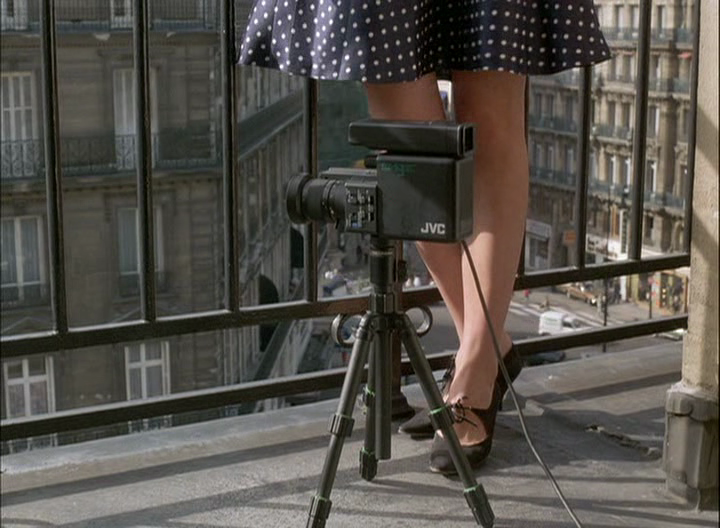
King Lear wrapped up my viewing of Godard's work from the 80's, and it is a dense, mystifying and often fascinating film - only loosely based on the canonical Shakespeare work - where Godard seemingly resurrects both the image and cinema from a zero state after a devastating nuclear catastrophe. The film follows a man by the name of William Shakespeare Jr. the Fifth (theatre director Peter Sellars) on a journey through a land nearly obliterated from the effects of the Chernobyl incident - which has destroyed all works of art as well as most of civilization - as he attempts to rediscover and collect the plays of his famous ancestor. He will cross paths with many important players along the way, among them: gangster Don Learo (Burgess Meredith) and his daughter Cordelia (Molly Ringwald); the mysterious Edgar and Virginia (after Allen Poe and Woolfe, played by Leo Carax and Julie Delpy); and the eccentric Professor Pluggy (Godard himself), a gravel voiced sorcerer donning a headpiece of audio/video wires who is obsessed with experimenting with various television screens and images. The film follows this group of characters as Professor Pluggy searches, through a variety of experiments, for what he calls "the first image".
I will give King Lear this - it never lost me. Or rather, it never lost my attention. I found the experience of watching it extremely muddled, and I was often scratching my head trying to discern what exactly was happening in the narrative (or what there was of one), but there are so many fascinating touches here that my mind was never allowed to wander in the midst of my confusion. The imagery is par for the course for 80's Godard - that is to say, excellent. And there is a wonderfully haunting ambient score lurking in the background, a touch I particularly loved that perfectly matched the gloomy apocalyptic atmosphere. The Professor Pluggy character played by Godard is really fun and quirky, and while I couldn't understand over half of what he was saying (I really wish this had come with subtitles, despite it being Godard's only full English language film), the stuff I did catch was mighty interesting, having to do mostly with the creation of images and the symbiosis between these images and human emotions. One sequence in particular stood out for me towards the end of the movie with the Pluggy character - involving him placing petals back onto flowers through reverse photography - as one of the more poetic and poignant scenes I've seen in these 80's films yet.
Similar to my experience with Passion, I can't really say how much I was able to glean from a single viewing of King Lear. As I've said, I did find it to be a consistently compelling film, though one with a bevy of murky elements that left me in the dark. Hopefully I will be able to sift through these on future viewings and the picture will congeal a little better for me. It did aid me to read the section for King Lear in Richard Brody's book Everything is Cinema and it helped shed light on some of the film's more confounding elements. I found it particularly helpful to learn that King Lear is a film fully informed and molded by the circumstances it was created in. For instance, in the curious opening, we see author Norman Mailer and his daughter (actress Kate Mailer) in a hotel room discussing adapting King Lear as a modern mafia story. We actually see the scene twice, the first time played through normally, and the second time with a voice-over from Godard, chastising Mailer for his "star behavior" and telling us how the writer and his daughter left the set for good after the scene we are viewing was shot. It turns out that Mailer was originally tapped to pen the screenplay of the film for Godard, then eventually agreed to actually star in the film, but found Godard to be so disagreeable on his one day of shooting that he quickly abandoned the movie entirely. I had no idea what to make of that beginning initially, but I found the Mailer anecdote to be fascinating, and I am always intrigued by a film like this that incorporates the biographical aspects of its production into the final product; it's really interesting stuff.
I went back and watched Passion again the day after my original viewing, and that confirmed for me that the film was a true masterpiece and one of my very favorite Godard's yet. While I can't speculate as to whether the case will be the same for King Lear (Passion hit me emotionally on a gut level; King Lear didn't really at all), it is a movie I feel almost as equally compelled to revisit immediately, and to read as much information available on it that I can get my hands on. Though this first viewing left me with a bit of uncertainty, the film has genuinely intrigued me and even haunted me a bit, and I suspect there to be a wealth of ideas and revelations for me to discover in King Lear past the single, hazy experience I had with it.